
Our Blog
AC Blowing Warm Air? Fixes and When to Call an Engineer
Quick answer: If your air-conditioning unit blows warm air, start by checking your thermostat mode and temperature setpoint, then inspect your filters and outdoor unit for blockages. If those checks don't resolve it, the cause is likely a refrigerant leak, frozen coil, or electrical fault—all of which need a qualified F-Gas engineer.
There's nothing quite like switching on your air con on a warm day, settling in for some blissful cool air, and getting a face full of warm. It's frustrating, especially when the unit sounds perfectly fine. It's running, the lights are on, the fan's blowing—yet somehow, air con not cooling is exactly what you're dealing with.
The good news? Some causes are simple to fix yourself in a few minutes. Others need a qualified engineer. This guide walks you through both: the safe DIY checks you can run right now, the deeper causes to be aware of, and a clear line between what you can do and what you shouldn't attempt. If you're in Essex, Kent, or Cambridge and need professional help at any point, we're here—but let's start at the beginning.
First, rule out the "easy stuff" (takes 5 minutes)

Before you assume something's seriously wrong, run through this quick checklist. You'd be surprised how often these are the culprit.
Is it in cooling mode? Most modern split systems can heat as well as cool. Check your remote or wall controller and make sure it's set to cooling mode (usually a snowflake symbol), not heating, auto, or fan-only.
What's the setpoint? If the room is already at or below your target temperature, the unit won't push cold air. Try dropping it to 18–20°C as a test.
Is it on a low fan speed or "quiet" mode? A very low fan speed can make the airflow feel underwhelming or even slightly warm at the grille. Increase the fan speed and see whether anything changes.
Are timers or schedules interfering? Some units have built-in scheduling that can switch modes unexpectedly. Check the settings on your controller.
Are windows, doors, or heat sources contributing? A south-facing room in July with a laptop, a server rack, and a sunny window is fighting against any system. Close doors, draw blinds, and remove heat sources where possible.
It's not always the unit being dramatic. Sometimes, it's just the thermostat blame game.
If your air-conditioning unit blows warm, check airflow and filters
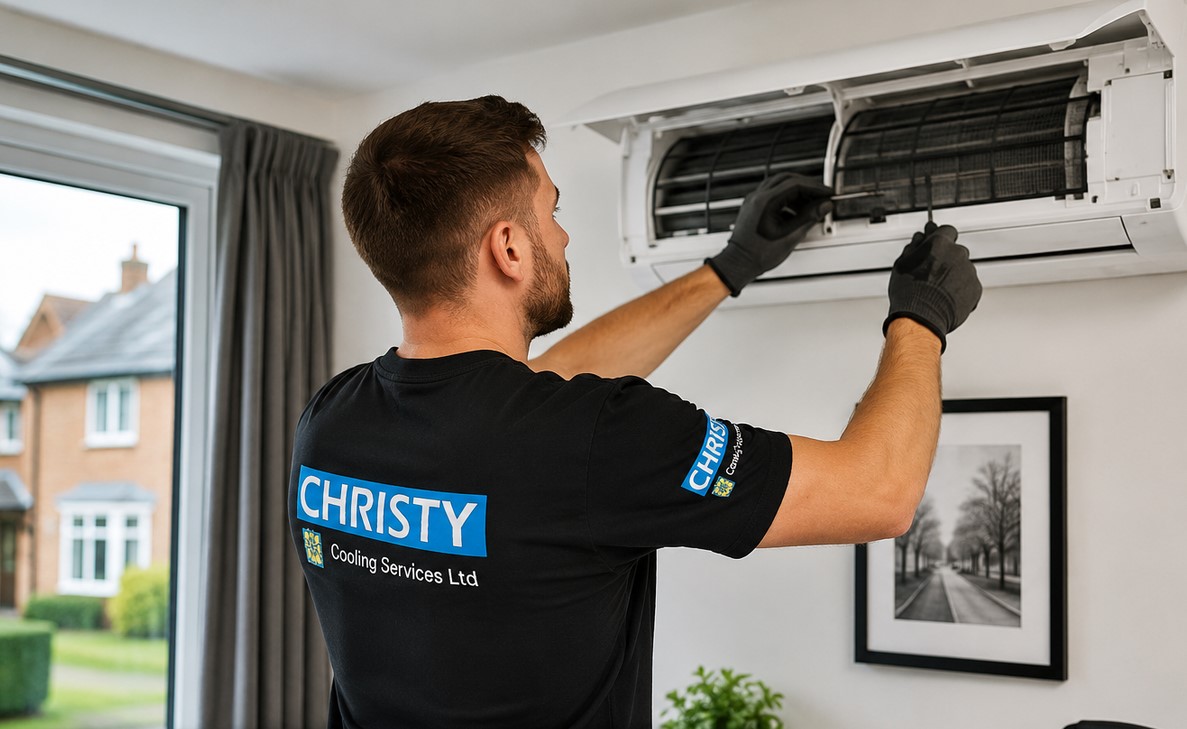
Restricted airflow is one of the most common reasons an air-conditioning unit blows warm—or at least warmer than it should.
Dirty filters (the most common culprit)
Filters sit inside the indoor unit and capture dust, pet hair, and general airborne debris. When they're clogged, airflow drops sharply. The evaporator coil gets too cold, ices over, and the unit struggles to transfer heat properly. The result? Weak, warm, or no cool air at all.
Signs of a dirty filter include reduced airflow, a musty smell, and in some cases visible dust around the indoor unit.
Safe steps to clean them:
Switch the unit off at the controller and isolate it at the wall switch.
Open the front panel of the indoor unit (most lift or clip open—check your manual).
Remove the filters carefully and take them outside.
Tap them gently to remove loose dust, then rinse with lukewarm water.
Leave them to dry fully before refitting—don't reinstall damp filters.
Refit, close the unit, and test.
This is something we recommend doing regularly—more on that in the maintenance section below.
Blocked vents or poor indoor airflow
Even with clean filters, airflow can be restricted by furniture placed directly in front of the unit, blinds or curtains draped over it, or simply years of dust build-up around the grilles. For ducted systems, make sure return air grilles throughout the property are unobstructed. A sofa pushed against a return grille will quietly undermine the whole system.
Check the outdoor unit (yes, it matters more than people think)

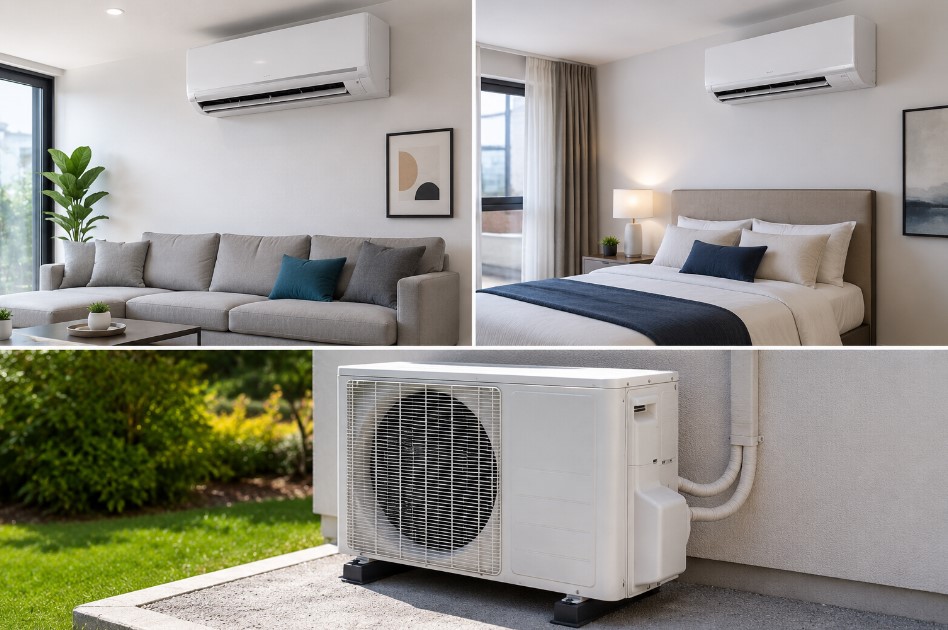
The outdoor unit (the condenser) is responsible for dumping the heat extracted from your indoor space. If it can't do that efficiently, cooling performance drops fast.
Is the condenser clogged or starved of airflow?
Leaves, grass clippings, seed fluff, and general garden debris build up on the condenser coil and around the unit over time. Fences, walls, or overgrown shrubs positioned too close can also restrict the airflow the unit needs to operate correctly.
Visually inspect the unit and clear away any debris around it. You can gently rinse the outer casing with a hose on a low setting to remove surface dirt—but don't aim water directly into the unit or at electrical components.
Is the fan running and is it unusually noisy?
Stand near the outdoor unit while the system is running. The fan should be spinning and expelling warm air from the top or side. If the fan isn't running, or you're hearing rattling, grinding, or a loud buzzing sound, stop the system and call an engineer. These are signs of a mechanical or electrical fault that shouldn't be left running.
Why warm air happens even when everything seems "on"
Sometimes everything looks normal—the unit's running, the filters are clean, the outdoor unit is fine—but cooling still isn't happening. Here's why.
Low refrigerant or a refrigerant leak (call an F-Gas engineer)
Refrigerant is the substance that makes cooling possible. Crucially, it doesn't get "used up" like fuel. If the charge is low, it almost always means there's a leak somewhere in the system.
Symptoms include longer-than-usual run times with little effect, noticeably weak cooling, a hissing or bubbling sound near the indoor or outdoor unit, ice forming on the pipework, and—yes—warm air.
Important: Under UK F-Gas regulations, only a qualified engineer holding the appropriate F-Gas certification is legally permitted to handle, recover, or recharge refrigerant. This is not a DIY job, full stop. Attempting it without the correct certification isn't just unsafe—it's illegal.
Our engineers hold City & Guilds 2079 F-Gas qualifications and we're Refcom F-Gas certified, so refrigerant diagnosis and repair is something we handle correctly and compliantly every time.
Frozen evaporator coil (ice inside = no cooling)
It sounds counterintuitive—ice inside the unit and still no cool air—but a frozen evaporator coil is a real problem. It's usually caused by restricted airflow (dirty filters being the prime suspect), low refrigerant, or a faulty sensor.
Safe action: Switch the unit off completely (don't just put it in fan-only mode if you suspect a fault), allow the coil time to defrost naturally—this may take a couple of hours—then retest. If it ices up again, book a diagnostic. Repeated icing points to an underlying issue that won't resolve itself.
Electrical or control faults
Capacitors, contactors, control boards, and relays can all fail and prevent the system from cooling properly even when the fan continues to run. You may also find that a tripped isolator or MCB (miniature circuit breaker) in the fuse board is causing intermittent issues.
If the MCB is tripping repeatedly, do not simply keep resetting it. This is the system telling you something is wrong. Contact a qualified engineer.
Incorrect system sizing or changes to heat load
Sometimes the unit itself isn't faulty—it's just undersized for the current space. A new extension, additional equipment (servers, large appliances), extra occupants, or more south-facing glazing can all push the heat load beyond what the system was designed for.
We assess every property properly before recommending a system. If you've had changes to the building since your air con was installed, it's worth having a conversation about whether the system is still appropriately sized.
Quick "warm air from AC fix UK" troubleshooting flow
Follow this in order before calling anyone:
Confirm the unit is in cooling mode with a setpoint lower than current room temperature.
Check and clean filters if needed.
Inspect vents and the outdoor unit for blockages.
Look for visible ice on the indoor unit or pipework.
Power cycle safely: switch off at the controller, wait two minutes, switch back on.
If the unit is still blowing warm after 15–20 minutes, stop and contact a qualified engineer.
If you smell burning, hear loud electrical buzzing, or notice excessive water leaking from the unit—switch off immediately and seek professional help.
When to call us (and what we'll do)
If the above checks haven't resolved the issue, it's time to bring in qualified help. A professional diagnostic visit from our team typically covers:
System pressure and temperature checks
Leak detection across the refrigerant circuit
Airflow measurement and assessment
Electrical testing of key components
Fault code retrieval from the controller
Performance verification once any faults are addressed
We've been trading for over 20 years and bring more than 30 years of wider industry experience to the work we do. We cover domestic and commercial properties across Essex, Kent, and Cambridge—from single bedroom units to offices, schools, retail spaces, and hospitality settings.
We also provide ongoing air conditioning maintenance and repair services, and as accredited installers we can offer extended warranties on select systems where replacements are needed.
No jargon, no hard sell—just practical advice and work done properly.
How to stop it happening again
A bit of regular attention goes a long way.
Clean filters every 4–6 weeks during heavy use periods—more frequently if you have pets or a dusty environment. Monthly is a reasonable default in summer.
Book an annual service. A professional check-up each year keeps the system efficient, catches small issues before they become expensive ones, and may help maintain warranty conditions.
Keep the outdoor unit clear year-round—a quick visual check every few weeks takes less than a minute.
Don't ignore changes in performance. If the unit's working harder than usual, taking longer to cool, or cycling on and off more frequently, these are early warning signs worth investigating before something fails mid-heatwave.
FAQ
Why is my air con not cooling but the fan is running?
The fan and the cooling function are operated separately. A running fan doesn't mean the system is actively cooling. Common causes include incorrect mode settings, a dirty filter, low refrigerant, a frozen coil, or a failed component in the refrigerant circuit. Work through the checklist above and call an engineer if the issue persists.
Can I top up refrigerant myself in the UK?
No. UK F-Gas regulations prohibit anyone without the appropriate F-Gas certification from handling, recovering, or recharging refrigerant. Doing so is illegal and potentially dangerous. If you suspect low refrigerant, contact a certified engineer.
How long should I wait for cold air after switching on?
Most split systems will begin delivering noticeably cool air within 5–10 minutes in normal conditions. If the room is very hot or large, it may take longer to bring the temperature down, but the air from the grille itself should feel cool within that window.
What temperature should I set my air conditioning to in summer?
For comfortable, efficient cooling in the UK, 21–22°C is a practical starting point. Setting it significantly lower won't cool the room faster—it'll just run the system harder. Small adjustments either side of this range based on personal preference are perfectly fine.
Is warm air a sign my unit is broken or just needs a service?
Not necessarily broken—but it does need attention. Warm air is often caused by dirty filters, incorrect settings, or a build-up of debris on the outdoor unit, all of which a service can address. More serious causes like refrigerant leaks or electrical faults do need repair work, which is why it's worth having a professional diagnose the issue properly.
Why is there ice on my air conditioning unit?
Icing on the indoor unit or pipework is usually caused by restricted airflow (dirty filters) or low refrigerant. Switch the system off and allow it to defrost, then check and clean the filters. If icing returns after this, book a diagnostic—it won't resolve itself.
Could a dirty filter really make the air warm?
Absolutely. A heavily blocked filter starves the evaporator coil of airflow, causing it to freeze over. Once the coil is iced up, heat transfer stops working properly and the system can only push warm or ambient-temperature air. It's one of the most common—and most fixable—causes of poor cooling.
Do you cover my area in Essex, Kent, or Cambridge?
Yes. We regularly work across Essex (including Chelmsford, Basildon, Southend, Rayleigh, and surrounding areas), Kent, and Cambridge, as well as areas including Bishop's Stortford, Stansted Mountfitchet, Sawbridgeworth, and Great Dunmow. If you're not sure whether we cover your postcode, give us a call and we'll confirm.
Still not cooling? Let's sort it out
If you've worked through this guide and your system still isn't performing as it should, it's time to bring in a qualified engineer. We're here to help—no fuss, no jargon, just a proper diagnosis and a sensible solution.

Get In Touch
If you need air conditioning installation, repairs or practical advice, get in touch with Christy Cooling Services. We’re happy to talk through your options, visit the property and recommend a system that suits the space properly.
With years of hands-on experience, Christy Cooling Services provides reliable, energy-efficient air conditioning installations and repairs tailored to homes and businesses across Essex, Kent and Cambridge.

Menu
Services
Address
HEAD OFFICE
Temple Wood Estate Stock Road
Chelmsford Essex CM2 8LP
© 2026. Christy Cooling Services LTD . All Rights Reserved | Acceptable Use Policy | Cookie Policy | Gdpr Regulations | Privacy Policy | Regulations | Terms Of Use